
Why India is jobless?
"Unraveling India's Employment Paradox: A Multi-Faceted Approach to Bridging the Gap"

Recently, news making rounds on the Internet was the abysmally low packages offered at IIT Bombay. Similarly, ET reported that the MBA is seen as losing its edge. Even layoffs have become more common than ever, almost 20,000 techies were laid off in 2023 alone.
But what are the reasons for this current unemployment status?
Let’s discover this looming issue in-depth and discuss some solutions.
Unemployment is the state in which an individual, who is not employed, is looking for work but is unable to find any work. The unemployment rate in India is over 8% as per various industrial reports. Let’s try to understand its meaning using an illustration.
The unemployment rate of 8% does not mean that out of 100 people, 8 people are unemployed; rather it is calculated as the ratio of the unemployed (people able and willing to work but don't have a paid job) to the Labour Force Participation Rate (LFPR). This means the total number of people in the working age (15-59 years) who are employed or actively looking for work). As of 2023, this number stands at 58.3%.
The below infographic highlights the math of unemployment numbers:
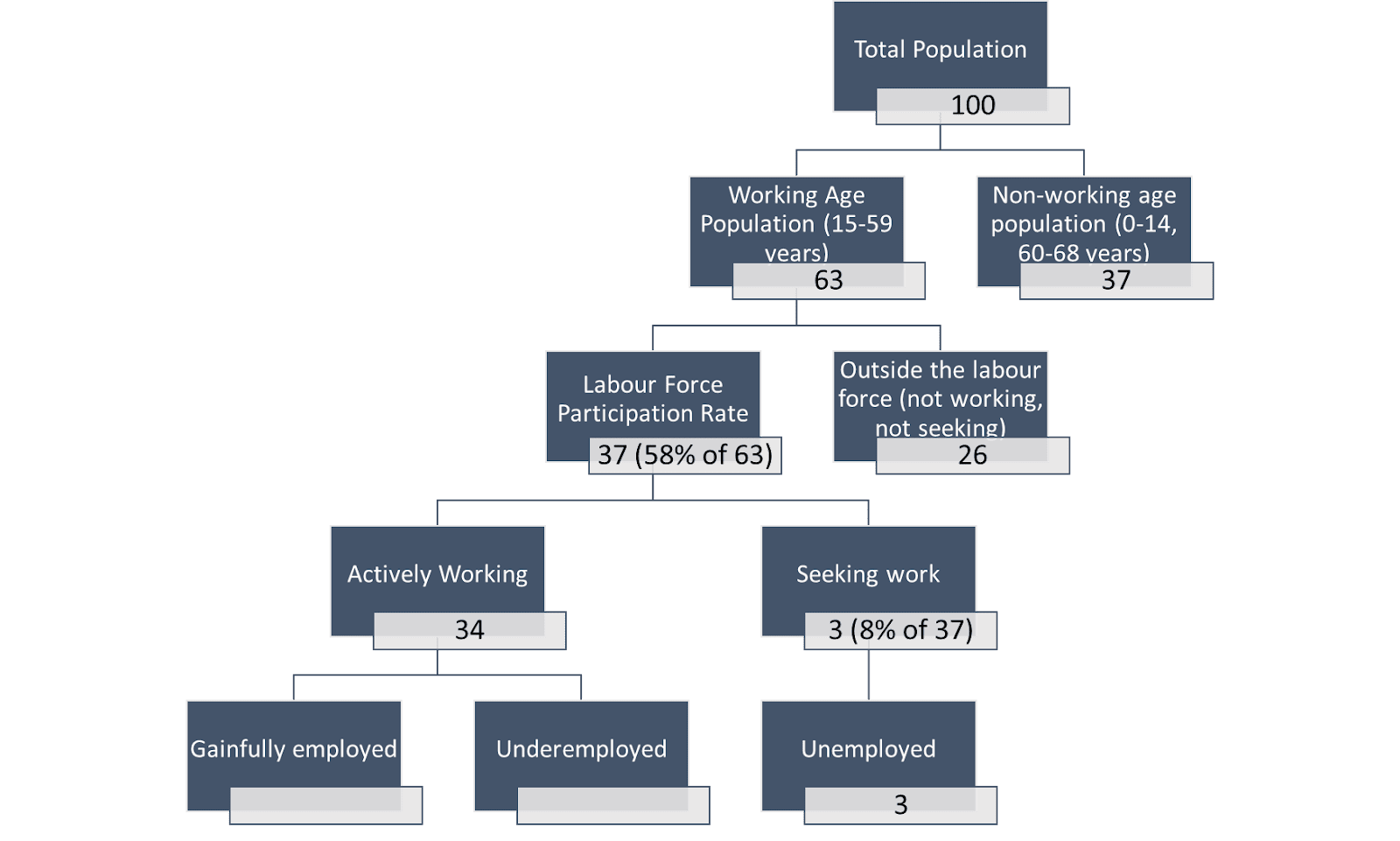
India’s working-age population of 63% is one of the highest numbers in the world, hence the possibility of converting this demographic bulge into a demographic dividend is a part of every prime time. But of this, approximately 42% (26% of the total population) are in the NEET (Not in Education, Employment, or Training) category. The reasons as observed are:
The industry-academia gap contributes to a lack of skills, rejections, and frustration making people out of the workforce.
The Vocational training market is underdeveloped in India, and it is poorly integrated with the mainstream education system. Further, the social stigma associated with working as “laborers” discourages people from choosing this path despite the demand.
The economic constraints or the events of life may lead to dropping out from formal education and the gap years might further deter them from training or formal occupation.
Women may choose not to work after marriage, due to family obligations, ‘sufficient’ income at home, or the “family reputation”.
The regional disparities in terms of the rural-urban divide, hilly areas, and the ensuing lack of industries, and infrastructure may push people into the NEET category.
An ideal LFPR for India should be around 65% vis-a-vis 58.3% currently. To achieve this, our country requires significant social, economic, and administrative reforms. The solution to address unemployment is a complex affair as it involves bringing those individuals into the labor force who are neither identified nor interested. The quick and easy wins would be to tap those who are already seeking work but are not able to find any suitable employment. The reasons as identified are:
Gendered nature of unemployment
(a) As per the Ministry of Statistics and Programme Implementation (MoSPI), the Female Labour Force Participation Rate stands at 37%. Though this has improved in recent years, it is still significantly lower than the global average of 50% (World Bank), 75% for OECD countries, and 61% for China.
(b) The parity in higher education (GER of women is 48% of total students, AISHE) doesn’t translate to equivalent jobs due to firms' reluctance to hire women in the high-fertility age (refer to the below exhibit- highest variation is in the age group of 20-29 years
(c) The motherhood penalty, dual burden (as per ILO, 80% of domestic unpaid work is done by women), and safety concerns (India’s top publicly traded companies saw a 70% surge in sexual harassment complaints during FY2023 over FY 2022, Mint) also discourage women from pursuing formal employment.
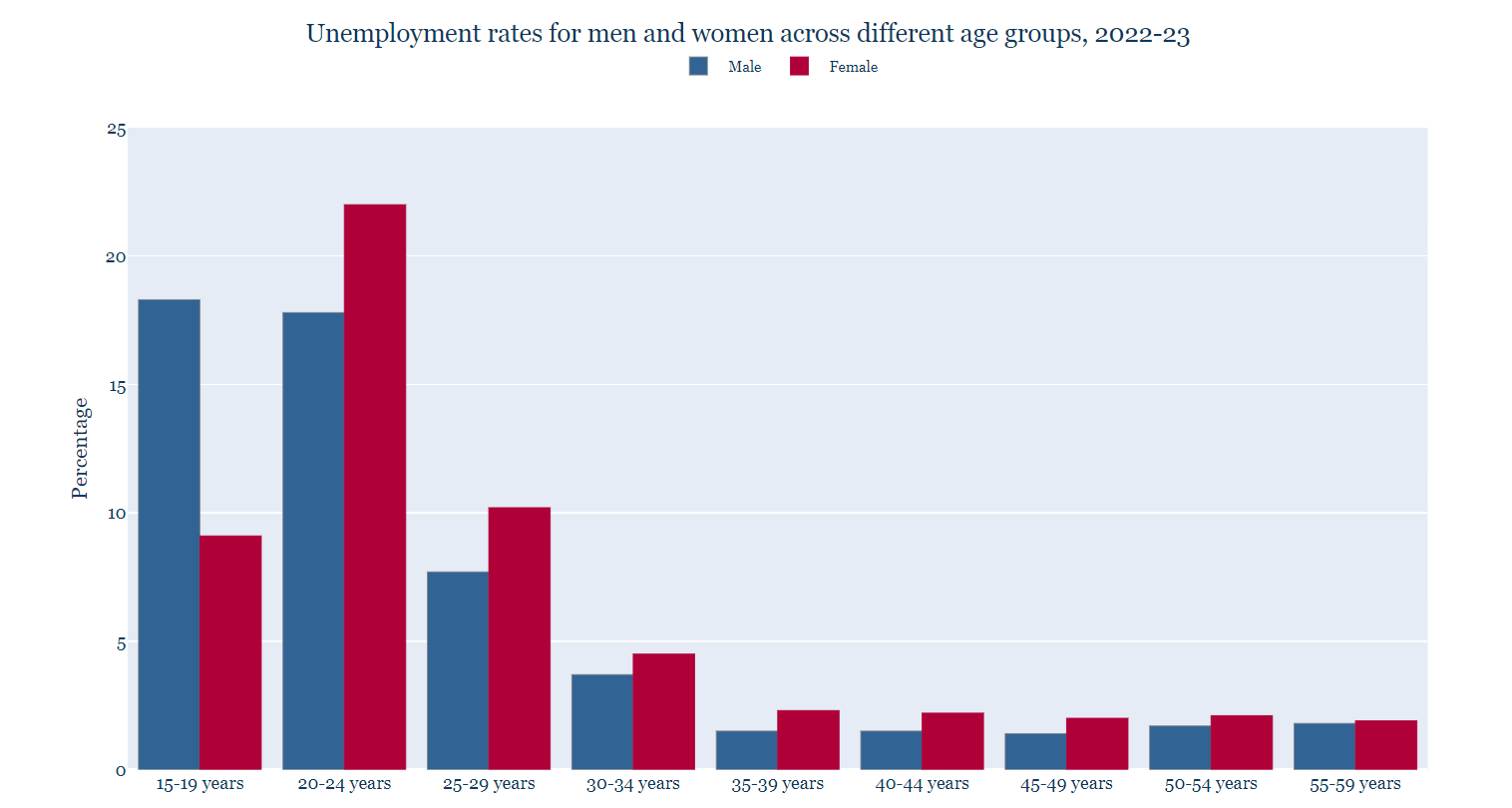
Source- Periodic Labour Force Survey 2022-23; Analysis by CEDA- Akshi Chawla, Kulvinder Singh
Lack of structural transformation leads to slow employment generation. India skipped the conventional agrarian->manufacturing-> services transition.
(a) We witnessed not only premature deindustrialization but also premature non-industrialization as we never industrialized sufficiently in the first place, due to multiple reasons from socialistic style policies, license raj, import substitution, MRTP, global competition, etc.
(b) The manufacturing sector can absorb massive semi-skilled or low-skilled workers but most services require high skills; (0.4% of the Indian population contributes 7.5% of the Indian GDP)
(c) The complex regulatory procedures and labor laws (retrenchment, trade unions) also deter firms from investing in labor skills, education, expansion, etc.
Note: China capitalized on the hyper-globalization era of the early 2000s with its low-cost exports which India was not able to do due to a lack of integration with Global Value chains and a lack of competitiveness.
Rising expectations of people can also contribute to unemployment
(a) With higher educational qualifications and aspirations due to globalization and exposure to the Western lifestyle, people may refuse job offers- leading to wage-induced and voluntary unemployment
(b) Rising wage expectations put pressure on Small and Marginal Enterprises (SMEs), leading to lower openings and overall low employment generation
(c) The prestige, social mobility, and security associated with government jobs may also push people to half-hearted attempts to find suitable jobs (Approximately 12 lac people register for the most competitive exam, i.e., UPSC for less than 1000 odd jobs
Skill mismatch, As per the Skill Assessment test, only 1 out of 2 Indians are employable while the majority lack the requisite skills and training required to compete in the fourth Industrial Revolution and knowledge economy.
The impact of Automation and Artificial Intelligence affecting job creation.
(a) In 2020, Gartner predicted that 69% of routine work currently done by managers will be automated by 2024.
(b) The layoffs in middle management roles have almost increased from 19.7% in 2018 to 31.5% in 2023. A report by Bloomberg states that this is because it is believed that they have higher salaries and usually don’t contribute to a project directly.
(c) The repetitive, clerical tasks that can be easily automated with the advent of AI are also under the axe of employment.
Problems in the calculation of unemployment itself
(a) Household productive activities are not considered remunerative by the people, hence counted as unemployed (eg- Dairy Farming).
(b) Survey questionnaires in affirmative or negation with lack of recovery questions, for example: Are you employed? (Yes/ No) and not asking the clarification questions may also underreport the actual unemployment figures
(c) There is no formal way to capture underemployment (where people are employed but not in a way that fully utilizes their skills, experiences, and learnings leading to wastage of human potential and dissatisfaction)
Solution: A multi-faceted problem requires multi-faceted solutions
Unemployment has been an issue not only for India but many economies across the globe. It puts a huge risk to the potential economic growth making it all the more pressing to reevaluate existing solutions, scout newer and effective solutions, and swifter and result-driven execution. The solutions need to be envisioned differently for the immediate term and mid-term. Given the demographic cliff that India is standing on, we have to put all hands on deck sooner. We have broadly summarized a few shower-term and mid-term solutions:
Short term Solutions
Expanding, and integrating cottage and small-scale industries to employ people with low skills located in non-developed regions. For instance, the toy sector has seen a turnaround with the efforts of the Government, startup integration into the informal sector, changed image through GI tags, and marketing- ensuring brand building in a highly commoditized market. For instance, Channapatna toys of Karnataka, Kathputli (puppet dolls) of Rajasthan
Improving the care economy by creating public provision of childcare facilities like creches, improving wages of Anganwadi workers, companies' initiative to integrate day care centers et al, and offering “parental leave of 480 days” (Sweden model) can help women reclaim their potential in the outside employment.
Introducing bridge courses and marketing existing platforms like SWAYAM, and DIKSHA to skill youth struggling to find suitable employment
Realigning existing Govt schemes- Production Linked Incentive (PLI) which has a huge scope for employment generation in sectors like food processing, and textiles with extensive consultations with stakeholders
Midterm Solution
Launching Startup India 2.0 by incorporating learning from the past (enhanced standards, disclosure norms, and investor protection to encourage investments) and promoting frugal innovation with huge potential in Tier 3 and Tier 4 cities.
Emerging sectors like green energy transition and semiconductors have the potential to create massive job opportunities and the ensuing economic growth. Along with the financial support, and policy support in terms of customized infrastructure solutions to investors (Singapore Model), investment in R&D can have a spillover effect.
Upskilling, reskilling, and cross-skilling of the existing workforce can go a long way in improving productivity while retaining the workforce. TCS and Wipro trained around 4 lakh employees in advanced Gen AI skills. This should become a norm more than an exception.
Creating a comprehensive database where companies can share their requirements with the government-appointed agency at the beginning of a year based on previous estimates. This agency should be the fulcrum that coordinates with colleges on the expected requirements. This should be assisted by independent experts, and technology upgradation to create a comprehensive one-stop solution for everyone.
While this may seem like a lot, India is on a significant trajectory to claim what many say is its “manifest destiny”. The distance between India in 2024 and India in 2047 will leap from the dream job of the millions.